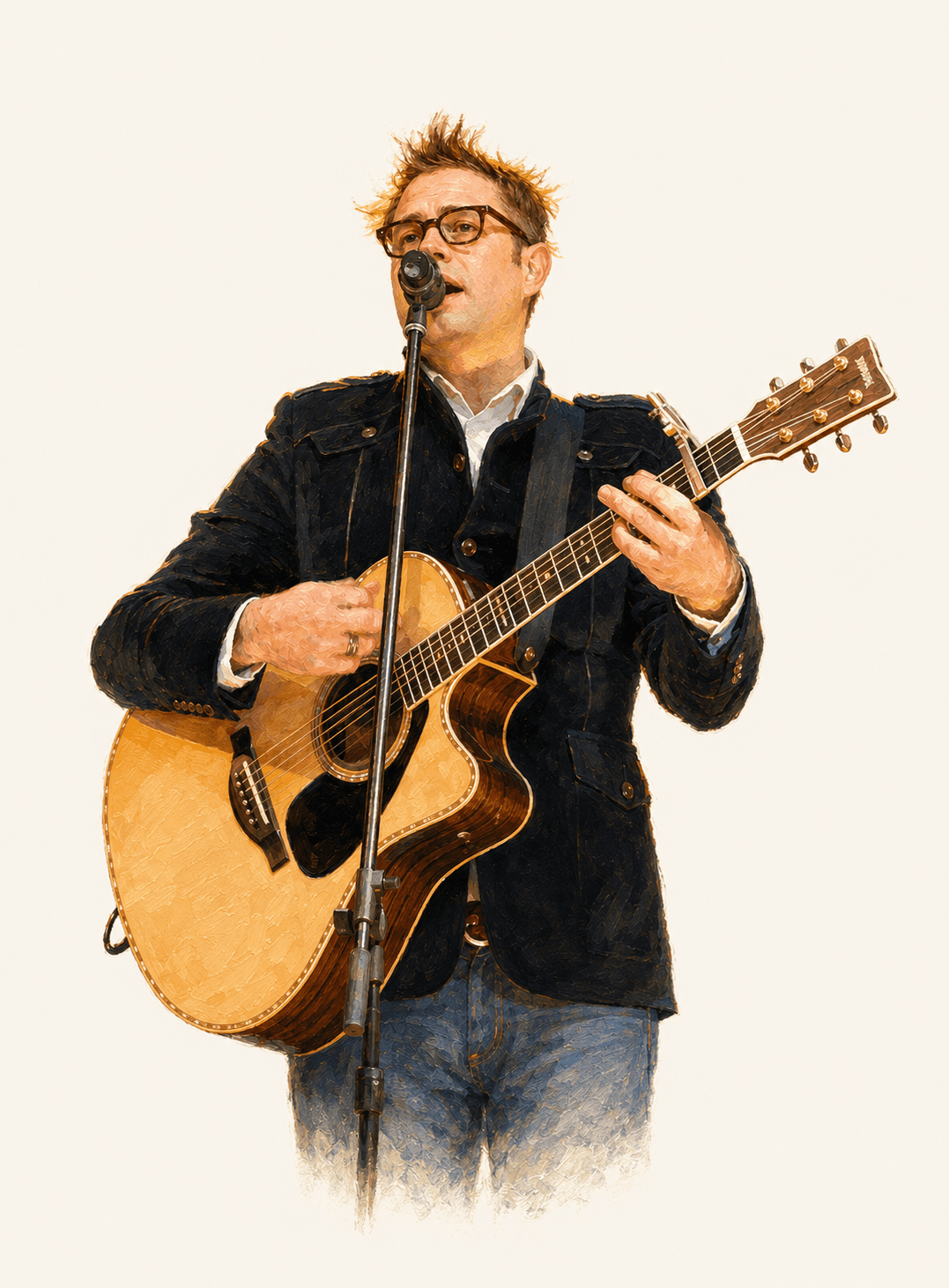
Steven Page at Cavalcade of Lights 2009.jpg
CC BY-SA 2.0
Painted adaptation; background changed to #f7f3ec by The Bipolar Biography Project.
Adaptation shared under the same license.
Full image attribution details
Steven Page
MusicianCanada
Steven Page is a Canadian singer and songwriter who co-founded Barenaked Ladies and served as one of the band’s principal singers and songwriters before leaving in 2009 to pursue a solo career. He has since released solo albums, toured independently and worked on projects including music for the Stratford Festival. [2]
Career and work
Page co-founded Barenaked Ladies with Ed Robertson in 1988 and became one of the band’s principal vocalists and songwriters. He co-wrote and sang on many of its best-known songs, including “Brian Wilson,” “If I Had $1000000,” “What a Good Boy” and “It’s All Been Done.” During his time with the group, Barenaked Ladies sold more than 15 million albums and received multiple Juno Awards, Billboard Music Awards and two Grammy nominations. [3][7]
Page left Barenaked Ladies in 2009 and continued as a solo artist, releasing several albums and touring independently. He has also collaborated with the Art of Time Ensemble, performed with the Steven Page Trio and developed the Live From Home concert series. [2]
What has been publicly discussed
- Page has said he was diagnosed at age 24, shortly after a severe depressive episode in 1994 when he became unable to get out of bed before a Barenaked Ladies video shoot. His family doctor diagnosed him with manic depression, the term then commonly used for bipolar disorder. [4]
- He kept his mental-health difficulties largely private for years. Page has said his bipolar disorder became public after his 2008 arrest for cocaine possession, and he subsequently began speaking much more openly about the diagnosis and his experiences with mental illness. [4]
- Page has described periods of severe depression in which ordinary functioning became difficult. In 1994, he recalled being unable to get out of bed on the day of a Barenaked Ladies video shoot, an episode that helped lead to his diagnosis. [4]
- Page has said medication has helped him, although finding treatment that worked was not always straightforward. He initially worried that medication would diminish his creativity and at times took it inconsistently; he later rejected the idea that depression was necessary to his work and said he began taking treatment more seriously. [5][4]
- He has also said he has a therapist he trusts. Page has described one medication making him feel emotionally numb and has emphasized that psychiatric medications can affect different people differently. [5][4]
- Page has described becoming more consistent about caring for his mental health. In 2019, he said he sought appropriate treatment, took better care of himself and felt more productive. [5]
- He has also avoided presenting himself as permanently “fixed.” In a 2016 interview, Page said he had learned to recognize depression and had developed better coping mechanisms, while emphasizing that difficulties still remained. He identified music as an important part of what helps him feel well. [6]
- Page has become an active speaker on mental health, sharing his experience at universities and Canadian Mental Health Association events. He has said that speaking publicly can give other people permission to discuss their own struggles, and has described being able to help others in this way as a “gift.” [5]
- He has also spoken about barriers to treatment. At a 2019 CMHA event, Page noted that he had been fortunate enough to afford private therapy during periods of crisis and expressed concern about people who lack comparable access to mental-health care. [1]
- Page has challenged the idea that mental illness is necessary for artistic creativity. He has said he once viewed depression as part of being a “tortured artist,” but later concluded that music was something that helped him cope with his mental-health struggles rather than something produced by them. [5]
“I seek appropriate treatment and take care of myself better now and I’m more productive than I ever was.”
— Steven Page [5]
Sources and other resourcesExpand to view the sources used in this profile and resources to learn more.
Sources used for this profile
The following sources contain information that supports the claims made on this page.
Windsor News Today“Former BNL frontman opens up about his own mental illness” Bipolar II and treatment access.
Steven PageOfficial biography Solo career.
Steven PageEPK Barenaked Ladies career and achievements.
View all 7 sources
University of Toronto“Steven Page and Mental Health Awareness Month” Diagnosis, depression, disclosure, medication and therapy.
519 MagazineSteven Page interview Treatment, advocacy and creativity.
Winnipeg Free Press“In Conversation with Steven Page” Coping and recovery.
BTPMSteven Page and Ed Robertson Formation of Barenaked Ladies in 1988.
Learn more
Recommended books and other resources about Steven Page and their experiences.