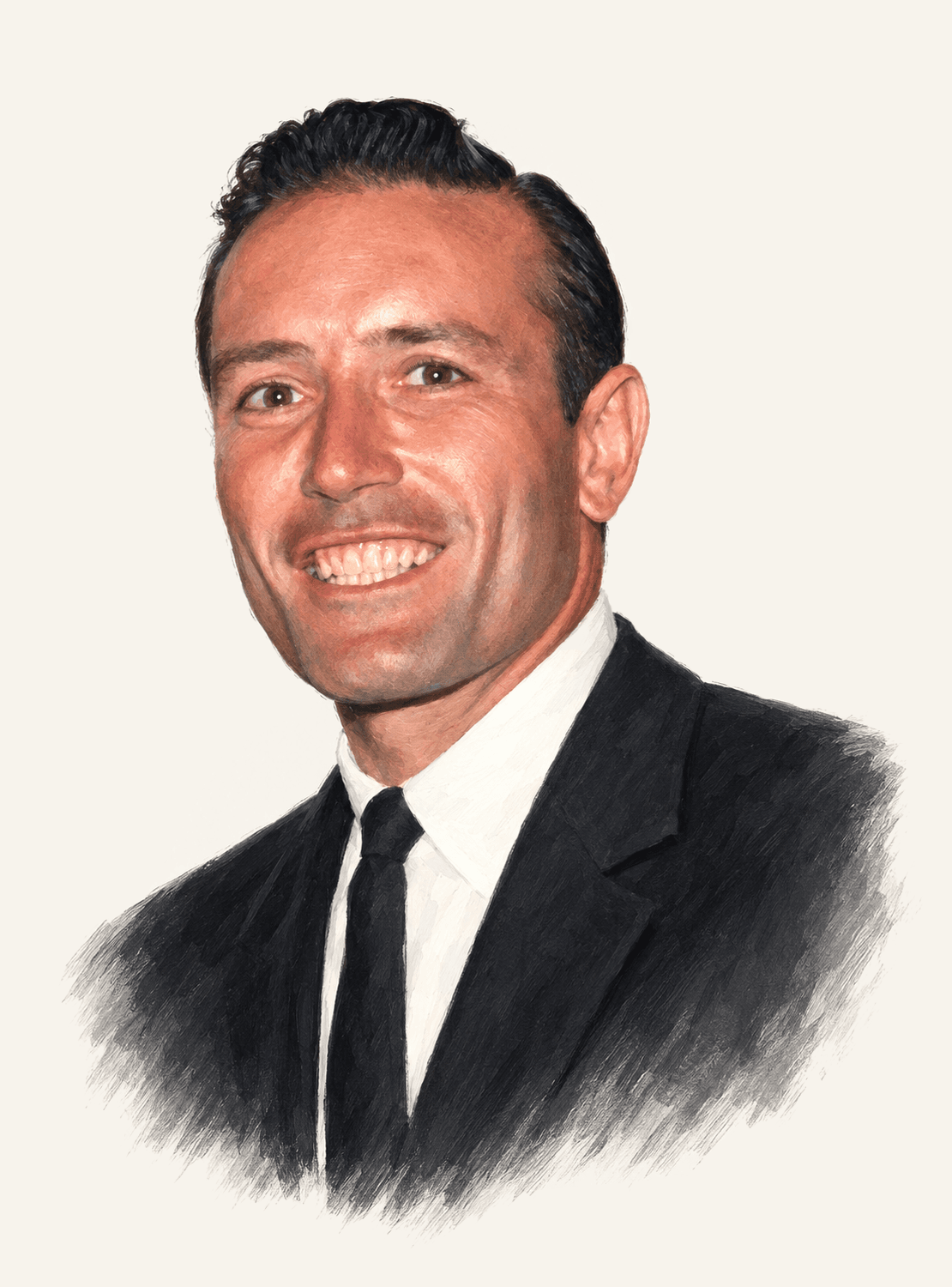
JFKWHP-KN-C22787 — President John F. Kennedy with Jimmy Piersall
Public domain (U.S. government work)
Painted adaptation; background changed to #f7f3ec by The Bipolar Biography Project.
Full image attribution details
Jimmy Piersall
BaseballBroadcaster
United States1929–2017
Jimmy Piersall was a Major League Baseball outfielder who played 17 seasons, most prominently with the Boston Red Sox. He was a two-time All-Star and two-time Gold Glove winner and later worked in baseball broadcasting and instruction. [3]
Career and work
Piersall played parts of 17 seasons in Major League Baseball from 1950 to 1967, including eight seasons with the Boston Red Sox. Known especially for his defensive play in center field, he was selected as an American League All-Star in 1954 and 1956 and won Gold Glove Awards in 1958 and 1961. In 1956, he led the major leagues with 40 doubles and was named the Red Sox’s Most Valuable Player. [3]
After his playing career, Piersall remained involved in baseball through coaching, instruction and broadcasting. [3][1]
What has been publicly discussed
- Piersall was diagnosed with manic depression, the term then used for what is now called bipolar disorder, during a psychiatric hospitalization in 1952. He later wrote publicly about the illness in his 1955 autobiography, Fear Strikes Out. [1]
- During the 1952 season, Piersall’s behavior became increasingly erratic and disruptive. He argued frequently with umpires, fought with players, received repeated ejections and suspensions, and displayed unusual behavior on and off the field. After his condition worsened following a demotion to Birmingham, he was hospitalized for psychiatric care. [2][1]
- Piersall later wrote that he remembered almost nothing of the period from the beginning of spring training until he regained awareness in the hospital that August. He also described episodes of agitation and confusion during his hospitalization. [2][1]
- During his 1952 hospitalization, Piersall received electroconvulsive therapy and was prescribed medication to stabilize his moods. [1]
- Piersall later continued taking lithium long term; the Society for American Baseball Research reports that he was still taking it about 50 years after his hospitalization. [1]
- After several months away from baseball, Piersall’s doctors allowed him to return for spring training in 1953. He regained a regular place with the Red Sox and later recalled being treated well by teammates, opponents, umpires and fans when he returned. [1]
- Piersall became one of the earliest prominent professional athletes to speak publicly about serious mental illness. In 1954, he discussed his experience on television, then expanded on it in a Saturday Evening Post series and his 1955 memoir Fear Strikes Out. [4]
- At a time when mental illness was rarely discussed openly, those disclosures brought his experience to a national audience. He also faced spectators who mocked him because of his psychiatric history. [4]
“I felt if they learned how I had conquered mine, they would become enheartened in their own efforts at rehabilitation.”
— Jimmy Piersall [1]
Sources and other resourcesExpand to view the sources used in this profile and resources to learn more.
Sources used for this profile
The following sources contain information that supports the claims made on this page.
Society for American Baseball Research“Jim Piersall” Detailed biography covering his baseball career, diagnosis, hospitalization, treatment, return to baseball and long-term lithium use.
Society for American Baseball Research“Jim Piersall’s Tumultuous 1952 Season” Detailed account of the 1952 season and his subsequent hospitalization.
MLB“All-Star, Gold Glover Piersall passes away” Official career summary covering his 17 seasons, All-Star appearances and Gold Gloves.
View all 4 sources
NAMI“When Stigma Struck Out: The Jimmy Piersall Story” Discusses his early public disclosure and the stigma he encountered.
Learn more
Recommended books and other resources about Jimmy Piersall and their experiences.