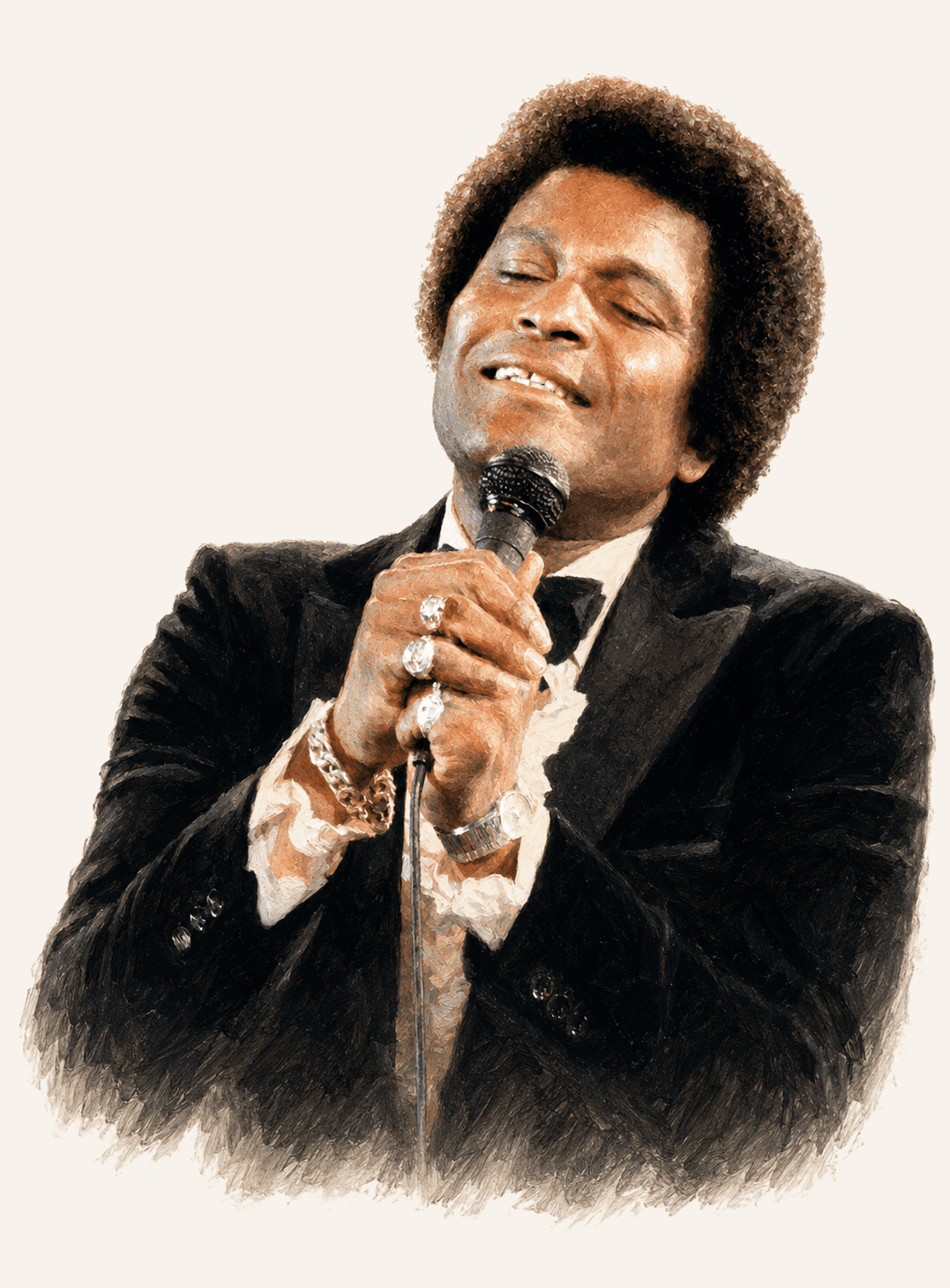
Charley-Pride 1981.JPEG
Public domain (United States)
Painted adaptation; background changed to #f7f3ec by The Bipolar Biography Project.
Full image attribution details
Charley Pride
SingerBaseball
United States1934–2020
Charley Pride was an American country singer and former professional baseball player who became country music’s first Black superstar. Between 1969 and 1983, he had 29 number-one country singles, won the Country Music Association’s Entertainer of the Year award in 1971, and was inducted into the Country Music Hall of Fame in 2000. Before his music career, he played professional baseball in the Negro American League and minor leagues. [2][3]
Career and work
Pride first pursued a career in professional baseball, playing in the Negro American League and later in minor-league organizations before injuries and military service helped bring that path to an end. He then turned increasingly toward music, eventually signing with RCA Victor in the 1960s. [1][3]
He became one of country music’s most successful performers, with hits including “Kiss an Angel Good Mornin’,” “Is Anybody Goin’ to San Antone” and “All I Have to Offer You (Is Me).” Pride won the Country Music Association’s Entertainer of the Year award in 1971 and Male Vocalist of the Year in both 1971 and 1972, and he was inducted into the Country Music Hall of Fame in 2000. [2]
What has been publicly discussed
- Pride said doctors first told him he had manic depression—the term then commonly used for bipolar disorder—after a psychiatric hospitalization in 1968, but he did not accept the diagnosis at the time. After later episodes, he came to accept that he had the illness. [4][5]
- Pride later discussed manic depression publicly in his 1994 autobiography, Pride: The Charley Pride Story, and in interviews surrounding the book’s publication. [4][1]
- Pride described several severe episodes involving insomnia, confusion, paranoia and delusional thinking. His first major episode occurred in 1968; after days of heavy work and little sleep, he became confused and was hospitalized. [4][5]
- Pride said he experienced about three severe episodes in which he could lose track of where he was and believe he was seeing or feeling things that were not real. In 1989, paranoia and delusional thinking led him to enter a psychiatric ward in Dallas. [4][1]
- Pride eventually accepted long-term treatment with lithium after initially resisting the diagnosis. In a 1994 interview, he said he had been taking lithium for about three years and described having regular blood tests so doctors could monitor the medication level and adjust his dose. [4]
- His wife, Rozene Pride, later recalled that it took several episodes before he accepted that he needed medication. [5]
- Pride used his autobiography and interviews to encourage people with manic depression to seek treatment, describing the illness as treatable and controllable. His wife, Rozene Pride, later recalled that people approached them to say that his example had persuaded them to take medication they had been prescribed. [5][1]
“I finally came to terms with manic depression and lithium. I’ve taken lithium regularly for the past few years and have had no further bouts with manic depression.”
— Charley Pride [1]
Sources and other resourcesExpand to view the sources used in this profile and resources to learn more.
Sources used for this profile
The following sources contain information that supports the claims made on this page.
Society for American Baseball ResearchCharley Pride Baseball career, manic depression, hospitalization, treatment and autobiography.
Country Music Hall of FameCharley Pride Music career and awards.
Charley PrideOfficial biography Baseball and music career.
View all 5 sources
PBSA Word on Words: Charley Pride Episodes, diagnosis, lithium and stability.
PBSAmerican Masters: Charley Pride — I’m Just Me Family perspective and treatment.
Learn more
Recommended books and other resources about Charley Pride and their experiences.