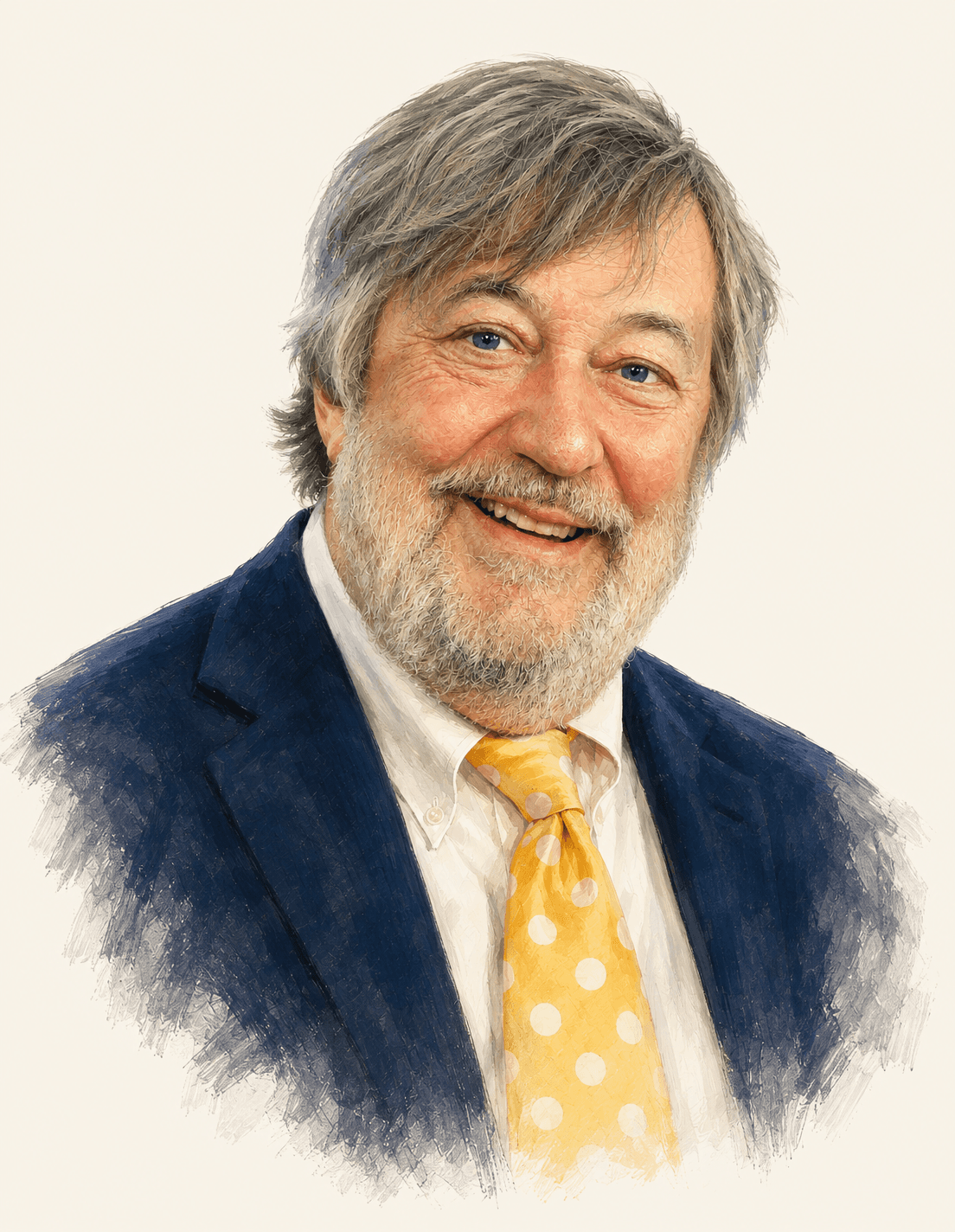
Stephen Fry
ActorComedian
WriterUnited Kingdom
Stephen Fry is a British actor, comedian and writer whose career has spanned television, film, literature and documentary work. He is particularly known for his work in Blackadder, A Bit of Fry & Laurie, Jeeves and Wooster and QI, as well as for his books and documentaries.
Career and work
Fry began performing with the Cambridge Footlights while studying at the University of Cambridge, where he met Hugh Laurie. The two later formed the comedy partnership Fry and Laurie, co-writing and starring in A Bit of Fry & Laurie and appearing together in Jeeves and Wooster. [6]
His acting work has included Blackadder, the film Wilde, V for Vendetta, Sherlock Holmes: A Game of Shadows, The Hobbit films and It’s a Sin. He also hosted the BBC quiz show QI for many years and has written and presented numerous documentaries. [6]
Fry has also had a substantial writing career. His books include the novels The Liar, The Hippopotamus, Making History and The Stars’ Tennis Balls, several autobiographical works, and his retellings of Greek mythology, including Mythos, Heroes and Troy. [6]
What has been publicly discussed
- Fry has said that he was first diagnosed as bipolar at age 37, following the severe depression and crisis surrounding his departure from the West End production Cell Mates in 1995. He later said the diagnosis helped explain the extreme highs and lows he had experienced throughout his life. [1]
- Fry has described periods when his mood becomes extremely elevated and he can go several nights without sleeping. During these periods, he has said he becomes highly energetic and talkative, feels unusually confident and grandiose, writes constantly, and sometimes goes on shopping sprees. [2]
- He has also experienced severe depressive episodes, including periods of suicidal thinking even while continuing to work and appear outwardly cheerful. In 1995, after leaving the West End production Cell Mates, he described coming close to killing himself before fleeing Britain. [1]
- Fry has also publicly discussed a suicide attempt in 2012 while filming abroad. He was found unconscious in his hotel room by a producer and was subsequently taken back to England for care. [2]
- After his 2012 suicide attempt, Fry began seeing a psychiatrist and was admitted to hospital. His psychiatrist has said that treatment included anti-manic medication, and Fry later continued taking medication to help control his mood swings. [3]
- In the 2016 documentary, he described becoming more careful about factors that could destabilize his mood, while his psychiatrist discussed the effects of extensive travel, changing time zones and disrupted routines. [3]
- Fry has described bipolar disorder as a continuing condition rather than something he considers cured. More recently, he has said that his mood has been relatively stable and that the stability of his marriage has helped him feel calmer and happier. He has also emphasized that the condition remains something he needs to manage. [4]
- Fry has become a prominent public advocate for mental health. In 2006, he presented the BBC documentary The Secret Life of the Manic Depressive, using his own experience and interviews with others to explore life with bipolar disorder and challenge stigma around the condition. He returned to the subject in the 2016 documentary The Not So Secret Life of the Manic Depressive: 10 Years On. [5]
- In 2011, Fry became president of the mental health charity Mind. He has said that he wants to address both the stigma surrounding mental illness and the lack of diagnosis that can make mental health conditions harder to live with. [5][8]
“What I had to learn was to treat my moods like the weather.”
— Stephen Fry [7]
Sources and other resourcesExpand to view the sources used in this profile and resources to learn more.
Sources used for this profile
The following sources contain information that supports the claims made on this page.
The GuardianStephen Fry: my long battle with manic depression Covers Fry’s diagnosis at 37, his 1995 crisis and suicide attempt, and his account of living with extreme changes in mood.
The GuardianStephen Fry: recent attempted suicide a ‘close-run thing’ Supports Fry’s descriptions of elevated periods involving little sleep, increased energy, grandiosity, constant talking and shopping, as well as severe depression and his 2012 suicide attempt.
BBC documentary transcriptThe Not So Secret Life of the Manic Depressive: 10 Years On Provides Fry’s discussion of treatment and management in the 2016 follow-up to his original documentary.
Documentary transcript
View all 8 sources
The IndependentStephen Fry says ‘stability of marriage’ helped him manage bipolar disorder Supports Fry’s more recent description of bipolar disorder as a chronic condition and his comments about feeling calmer and happier during a relatively stable period.
MindCelebrity support and our president Documents Fry’s role as president of Mind since 2011 and his work raising awareness and challenging stigma around mental illness.
University of Cambridge AlumniStephen Fry Kt Provides biographical and career information, including Fry and Laurie, Blackadder, QI, his acting work, documentaries and books.
BiographyBig ThinkBig Think Interview With Stephen Fry Contains Fry’s description of learning to “treat my moods like the weather,” used for the profile’s quotation.
InterviewStephen FryMind OutEssay
Learn more
Recommended books and other resources about Stephen Fry and their experiences.
- Stephen Fry: The Secret Life of the Manic DepressiveDocumentary · BBC, 2006
A two-part documentary in which Fry examines bipolar disorder through his own experience and conversations with other people living with the condition.
- The Not So Secret Life of the Manic Depressive: 10 Years OnDocumentary · BBC, 2016
Fry revisits bipolar disorder a decade after the original documentary, including changes in his diagnosis, treatment and understanding of the condition.
- Mind OutEssay · Stephen Fry
A personal essay in which Fry reflects on mental illness, suicidal thinking, stigma and his decision to speak publicly about his experiences.
- Stephen Fry opens up on his mental health and bipolar battleInterview · Today Show Australia, 2021
A later interview in which Fry discusses living with bipolar disorder and his mental health over time.
- Stephen Fry: “Lost, alone and I wanted to take my life”Interview · The Diary of a CEO, 2022
A long-form interview with Steven Bartlett covering Fry’s childhood, career, bipolar disorder, depression, suicidal experiences and how he has come to understand his mental health over time.
- Stephen Fry opens up about his bipolar disorderInterview · Larry King Now, 2016
Fry speaks with Larry King about living with bipolar disorder, his suicide attempts, and the complicated relationship some people have with both the depressive and elevated sides of the condition.