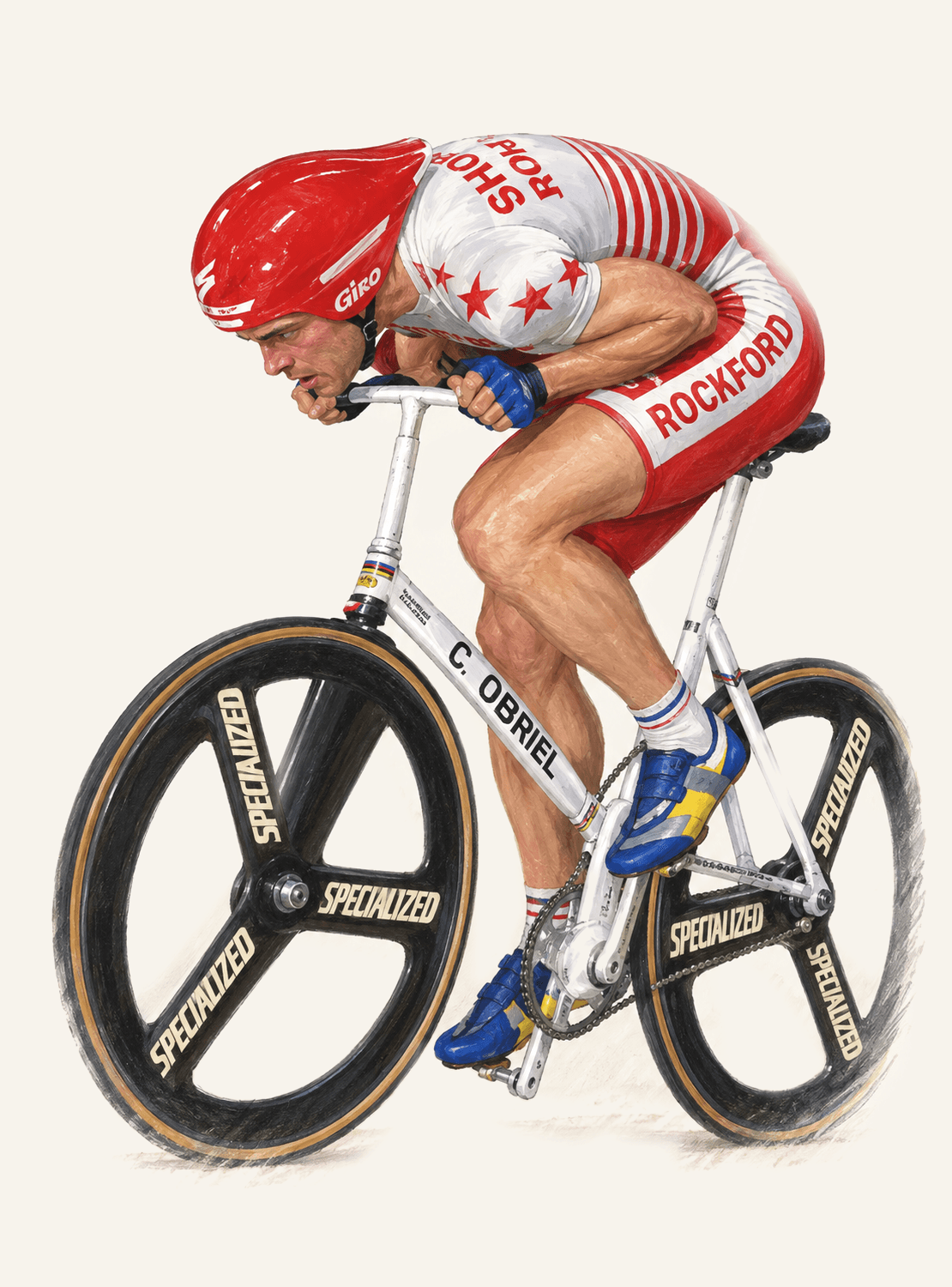
Graeme obree.jpg
Public domain (worldwide)
Painted adaptation; background changed to #f7f3ec by The Bipolar Biography Project.
Full image attribution details
Graeme Obree
CyclingUnited Kingdom
Graeme Obree is a Scottish former racing cyclist and cycling innovator. He twice broke the world hour record and twice won the world 4,000-metre individual pursuit championship, becoming known for unconventional aerodynamic riding positions and his self-built bicycle, Old Faithful. [1][4]
Career and work
Obree emerged as an elite track cyclist in the early 1990s while also developing his own bicycles and riding positions. On 17 July 1993, he broke the world hour record in Hamar, Norway, covering 51.596 kilometres in one hour on his homemade bicycle, Old Faithful. He later regained the record after it had been broken by another rider. [1][2]
He also won the world individual pursuit championship twice, in 1993 and 1995. Obree became known for experimenting with aerodynamics, including the highly compact “tuck” position he used while riding Old Faithful. After the Tuck was banned, he developed another extended-arm position called the “Superman,” which was copied by other riders before it too was banned. [1][2]
Old Faithful is now held by National Museums Scotland, where Obree is described as both a record-breaking cyclist and a sporting innovator. [1]
What has been publicly discussed
- Obree has said that he was eventually diagnosed as “manic depressive,” the term commonly used at the time for what is now called bipolar disorder. He discussed his mental illness publicly in interviews and in his 2003 autobiography, The Flying Scotsman. [2][3]
- He has described experiencing severe depression for years before receiving the diagnosis. By 2003, he was speaking publicly about both the diagnosis and his earlier suicide attempts. His autobiography also included his suicide attempts and his experience of severe mental illness. [3]
- Obree has described severe depression as a recurring part of his life, including during his cycling career, but said it became much worse after he retired from international competition. He described reaching a point where thinking itself felt painful and said he sometimes turned to alcohol in an attempt to cope with depression. [2][3]
- He made several suicide attempts, including attempts in 1998 and 2001. In the 2001 attempt, he was found hanging in a barn and was resuscitated after being cut down. Obree later spoke openly about the episode and described suicide as arising from an overwhelming desire to escape unbearable thoughts. [3]
- Obree has also connected periods of depression with major disruptions in his life, including the death of his brother in 1994, the end of his elite cycling career and difficulty adjusting to life after competition. He has said that cycling had previously served as an important way of coping with his mental health, and that losing that structure left him struggling significantly. [2]
- Obree has said that doctors were able to help him with medication after he was diagnosed with manic depression. [2]
- He has also described counselling and longer-term psychotherapy as important. In 2003, he credited work with a psychologist with helping him change how he responded when his mood began to deteriorate, including learning to express difficult feelings rather than withdrawing and allowing them to build up. [3]
- Obree has described gradually developing ways to live with depression rather than relying on cycling as his main means of coping. In 2007, he said that support from his family, counselling and medical treatment had helped him begin to address longstanding personal difficulties, and that he no longer felt compelled to prove himself through another cycling record. [2]
- By 2011, Obree said he had spent around ten years in therapy and had found his own ways of dealing with life and staying positive. He was also beginning new projects, including writing, organizing cycling events and becoming involved in community work. [4]
- Obree has spoken publicly about depression and suicide and has used his experiences to encourage more open discussion of those subjects. He has said that people have contacted him after reading or hearing his story to tell him they were struggling themselves, and he has described wanting to pass on some of what he learned through years of therapy. [4][6]
- He has also argued that elite sport can sometimes function as a coping mechanism for people who are already vulnerable to depression. Drawing on his own experience, Obree has said that cycling helped him cope, while also emphasizing that exercise alone does not address the underlying causes of depression. [6]
“I want people to understand what it’s like, how it felt.”
— Graeme Obree [3]
Sources and other resourcesExpand to view the sources used in this profile and resources to learn more.
Sources used for this profile
The following sources contain information that supports the claims made on this page.
National Museums ScotlandGraeme Obree: Breaking records on a homemade bicycle Provides career information including Obree’s 1993 World Hour Record, Old Faithful, his aerodynamic innovations and the Tuck and Superman riding positions.
article or webpageThe Guardian, 2007Graeme Obree: “It was after I retired that my depression really took hold of me” A first-person interview covering depression during and after his cycling career, alcohol use, his diagnosis as manic depressive, medication, counselling, family support and the role cycling had played in coping with his illness.
interviewThe Guardian, 2003Obree opens up on a story of speed, success and suicide A detailed interview about severe depression, suicide attempts, his 2001 attempt, psychotherapy and why he chose to write openly about his mental health in The Flying Scotsman.
interview
View all 6 sources
road.cc, 2011Graeme Obree Interview Part 1 Covers Obree’s cycling career and his reflections on depression, therapy and developing ways to manage his mental health over time.
interviewThe Guardian, 2011Graeme Obree: building bikes, writing books and beating depression Discusses Obree’s life after elite cycling, his mental health and his efforts to use his experience to help other people struggling with depression.
interviewCycling WeeklyGraeme Obree: why we need to talk about depression in sport Covers Obree’s perspective on depression in elite sport, exercise as a coping mechanism and the importance of addressing mental-health difficulties more directly.
profile or biography
Learn more
Recommended books and other resources about Graeme Obree and their experiences.
- The Flying ScotsmanBook · Graeme Obree, 2003
Obree’s autobiography covering his childhood, rise in elite cycling, world records, battles with cycling authorities, depression, suicide attempts and diagnosis of manic depression.
- The Obree Way: A Training Manual for CyclistsBook · Graeme Obree
Obree’s guide to cycling technique, training, psychology and performance, giving a broader view of how he approached sport and problem-solving beyond his autobiography.
- The Flying ScotsmanFilm · feature film, 2006
A dramatization of Obree’s life and cycling career, based on his autobiography and starring Jonny Lee Miller as Obree.